
Same target, four ADCs, one approval - what actually separated them?
Four companies built an antibody-drug conjugate against the same receptor and only one reached approval. What separated the winner from the failures - and could a machine work that out from public data alone?
Four antibody-drug conjugates were built against folate receptor alpha (FRα) in ovarian cancer, but only Mirvetuximab Soravtansine (Elahere) is approved. From a single prompt, Hydra benchmarked all four on public data in hours and found the lead comes mostly from patient selection - a choice anyone can copy - while payload permeability, which lets the drug kill neighbouring tumour cells, is the biggest untapped engineering lever.
Who this is for: ADC engineers, antibody and medicinal-chemistry teams evaluating or designing a next-generation antibody-drug conjugate.
- ADCs built against the same receptor; only one approved
- 4 → 1
- kicked off the entire benchmark, end to end
- 1 prompt
- to a fully sourced answer, not a quarter
- hours
- how weakly expression predicts whether a cell is actually killed
- r = 0.20
ADCs built against the same receptor; only one approved
kicked off the entire benchmark, end to end
to a fully sourced answer, not a quarter
how weakly expression predicts whether a cell is actually killed
Why does one ADC win when four chase the same target?
An antibody-drug conjugate (ADC) is a guided missile for cancer: an antibody finds a marker on the tumour cell, and a toxic payload it carries does the killing. Folate receptor alpha (FRα) is one of the most attractive markers in ovarian cancer, so four different companies each built an ADC against it. Years and hundreds of millions of dollars later, only one is approved, and the other three are still working to catch up. Same target, very different fates - and the obvious question is what actually made the difference.
The honest answer is buried across four unrelated kinds of data: how the trials were designed, how tightly each antibody grips the receptor, what the payload's chemistry is, and how the tumours behave at the molecular level. No single database holds the picture. Pulling it together by hand - reading dozens of trial records, a protein crystal structure, payload chemistry, and tumour gene-expression data, then reconciling them - is weeks of specialist work that most teams never get to finish before the next decision is due.
What teams in this space search for
- What separates a successful ADC from a failed one against the same target?
- Does my ADC payload need to be able to kill neighbouring cells (bystander effect)?
- How do I pick the right patients for an ADC trial?
How we solved it with Hydra
“Benchmark every clinical-stage ADC targeting folate receptor alpha (FRα) in ovarian cancer. Pull the competitive landscape, antibody binding and epitope geometry, payload physicochemistry, and tumour expression, then score each agent on affinity, epitope distance, payload permeability, and patient-selection stringency. Tell me what a best-in-class molecule would have to beat, and which dimensions are intrinsic to the molecule versus replicable programme design.”
How to build a best-in-class FRα ADC
Same target, four ADCs, one approval — what separates clinical success from development risk, and where the engineering opportunity lies.
Abstract
Four antibody-drug conjugates have been developed against the same target — folate receptor alpha (FRα) — in ovarian cancer. Only one, Mirvetuximab Soravtansine (Elahere, ImmunoGen/AbbVie), is FDA approved. From one prompt, Hydra integrated clinical-trial data (39 trials), structural biology (PDB 4LRH), payload cheminformatics, and tumour transcriptomics (TCGA, n≈300), and scored every agent on intrinsic ADC properties and clinical-programme design.
The headline: Mirvetuximab’s composite lead (0.739) is dominated by its patient-selection programme, not by intrinsically superior engineering. The biggest untapped lever for a best-in-class entrant is payload permeability — the property that lets a released drug kill neighbouring tumour cells the antibody never bound.
1. Introduction
Folate receptor alpha (FRα, encoded by FOLR1) is a GPI-anchored membrane protein that mediates folate uptake by receptor-mediated endocytosis. It is overexpressed in most epithelial ovarian cancers with limited normal-tissue expression — making it one of the most studied ADC targets in gynaecological oncology. Four companies independently built an FRα ADC, each making different antibody, linker, and payload choices.
| Agent | Company | Payload | Status |
|---|---|---|---|
| Mirvetuximab Soravtansine · Elahere | ImmunoGen / AbbVie | DM4 (maytansinoid) | FDA approved (2024) |
| STRO-002 / Luveltamab Tazevibulin · Luvelta | Sutro Biopharma | Hemiasterlin (tubulin inh.) | Phase III |
| MORAb-202 / Farletuzumab Ecteribulin | Eisai | Eribulin (tubulin inh.) | Phase I/II |
| Rinatabart Sesutecan (Rina-S) | Genmab / AstraZeneca | DXd / Exatecan (topo-I inh.) | Phase III |
Despite the shared receptor, the agents sit at very different stages of clinical maturity. The question is whether the competitors can close the gap by learning from the design choices behind Mirvetuximab’s progress — or whether they carry molecular disadvantages that patient selection alone cannot overcome.
2. Methods — in depthExpand
2.1 Clinical trial data mining
Records were retrieved from ClinicalTrials.gov (API v2) with multiple search terms per agent, deduplicated by NCT ID, yielding 39 unique trials. FRα-expression thresholds were extracted from eligibility criteria and classified as High (≥75%), Medium-High (≥50%), Medium (≥25%), Low/Any-positive, or Not-mentioned. This captures the proportion of each programme designed around biomarker enrichment from the outset — not that any single trial was inherently more stringent.
2.2 Structural & binding analysis
The FRα crystal structure (PDB 4LRH, 2.80 Å; Chen et al. 2013) characterised the folate pocket (17 contact residues within 4.0 Å of folic acid). Binding: Mirvetuximab/M9346A Kd = 1.8 nM (Ab et al. 2015), Farletuzumab Kd = 6.5 nM (Ebel et al. 2007). For STRO-002 and Rinatabart, no published Kd exists; a proxy of 3.42 nM (geometric mean of known values) was applied and flagged. Epitope: farletuzumab maps to aa45–57 (H/D-exchange MS); Mirvetuximab inferred from the shared LK26/MOv19 lineage; class-consensus epitope used as a proxy for the others.
2.3 Payload cheminformatics
Physicochemical properties for all four payloads were retrieved from PubChem. Membrane permeability was classified by published criteria: High requires XLogP ≥ 2.0 AND TPSA ≤ 140 Ų (Veber et al. 2002; Kovtun et al. 2006) — the thresholds relevant to the bystander effect.
2.4 Tumour biology: intracellular processing
For an ADC to kill a cell, the antibody must bind, the complex must internalise, and the payload must be released inside the lysosome — which depends on processing machinery. We asked: in high-FOLR1 tumours, is processing also efficient? Using TCGA ovarian RNA-seq (cBioPortal, n≈300), we correlated FOLR1 against five genes spanning the internalisation-to-killing pathway: CTSB (Val-Cit linker cleavage), CTSD (aspartyl protease), LAMP1 (lysosome abundance), RAB5A (early-endosome trafficking), and FOLR1 itself.
Caveat: mRNA is a proxy for surface protein. Post-translational processing, GPI-anchor assembly, recycling, and internalisation kinetics are not captured by bulk RNA-seq — results indicate transcriptional co-regulation, not protein co-expression.
2.5 Integrated scoring framework
Each ADC was scored on four normalised dimensions in two groups — ADC-specific (affinity score 1 − Kd/max; epitope-distance score; permeability High = 1.0 / Medium = 0.5 / Low = 0.2) and patient selection (proportion of trials requiring explicit FRα thresholds). The composite is an equal-weighted mean. The value is not the composite number but exposing which dimensions are intrinsic to the molecule versus replicable programme design.
3.1 ADC-specific properties: binding, epitope, payload
Binding affinity. Mirvetuximab has the tightest measured binding (Kd = 1.8 nM). Farletuzumab (MORAb-202/Eisai) is weakest at 6.5 nM — a 3.6× gap. STRO-002 and Rinatabart lack published Kd; proxy estimates place them at 3.42 nM.
A 3.6× affinity gap is clinically meaningful: in moderate-FRα tumours, higher-affinity antibodies achieve greater receptor occupancy and internalise more ADC per cell. The 1.8 nM benchmark sets a competitive floor any best-in-class programme should match or beat.
Epitope positioning. All known clinical-stage anti-FRα antibodies converge on the aa45–57 region (~15.89 Å from the folate pocket), so they do not compete with folate for binding. That convergence limits epitope-based differentiation today — but a novel surface patch could differentiate a future agent, at the cost of unknown internalisation kinetics.
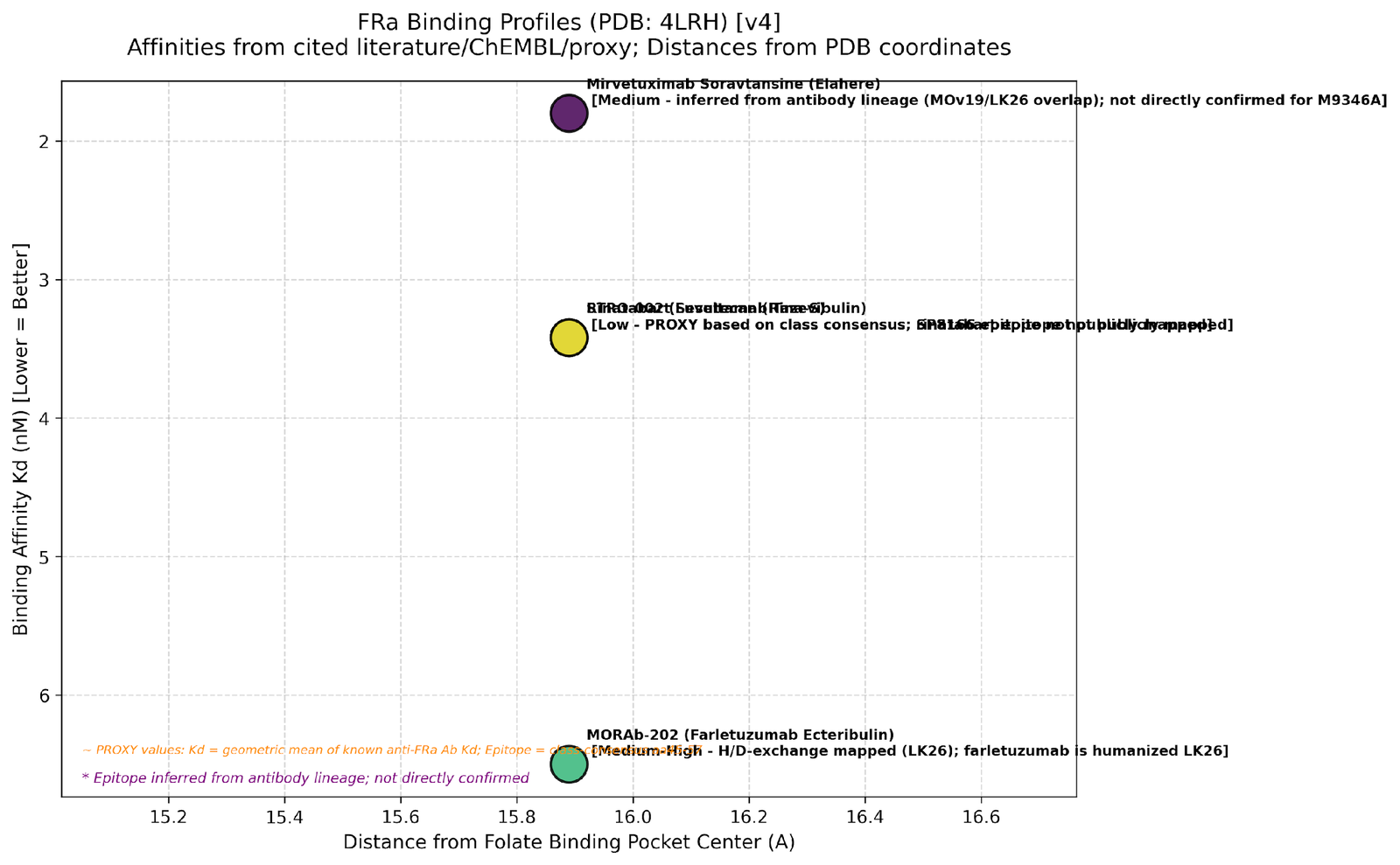
Epitope binding comparison. Mirvetuximab shows the highest affinity (Kd = 1.8 nM); all agents cluster at the same epitope distance (~15.89 Å), reflecting convergence on the aa45–57 immunodominant region. Triangle markers = proxy-imputed values.
Payload permeability — the most differentiating dimension. Unlike affinity and epitope, where the agents are similar, payload permeability varies strikingly. The four payloads span all three permeability classes.
| Payload (agent) | MW | XLogP | TPSA (Ų) | Permeability |
|---|---|---|---|---|
| Hemiasterlin (STRO-002 / Sutro) | 526.7 | 2.7 | 104 | HIGH |
| DM4 (Mirvetuximab / AbbVie) | 780.4 | 3.2 | 157 | MEDIUM |
| Eribulin (MORAb-202 / Eisai) | 729.9 | 1.1 | 146 | MEDIUM |
| DXd (Rina-S / Genmab–AZ) | 1034.1 | -0.4 | 301 | LOW |
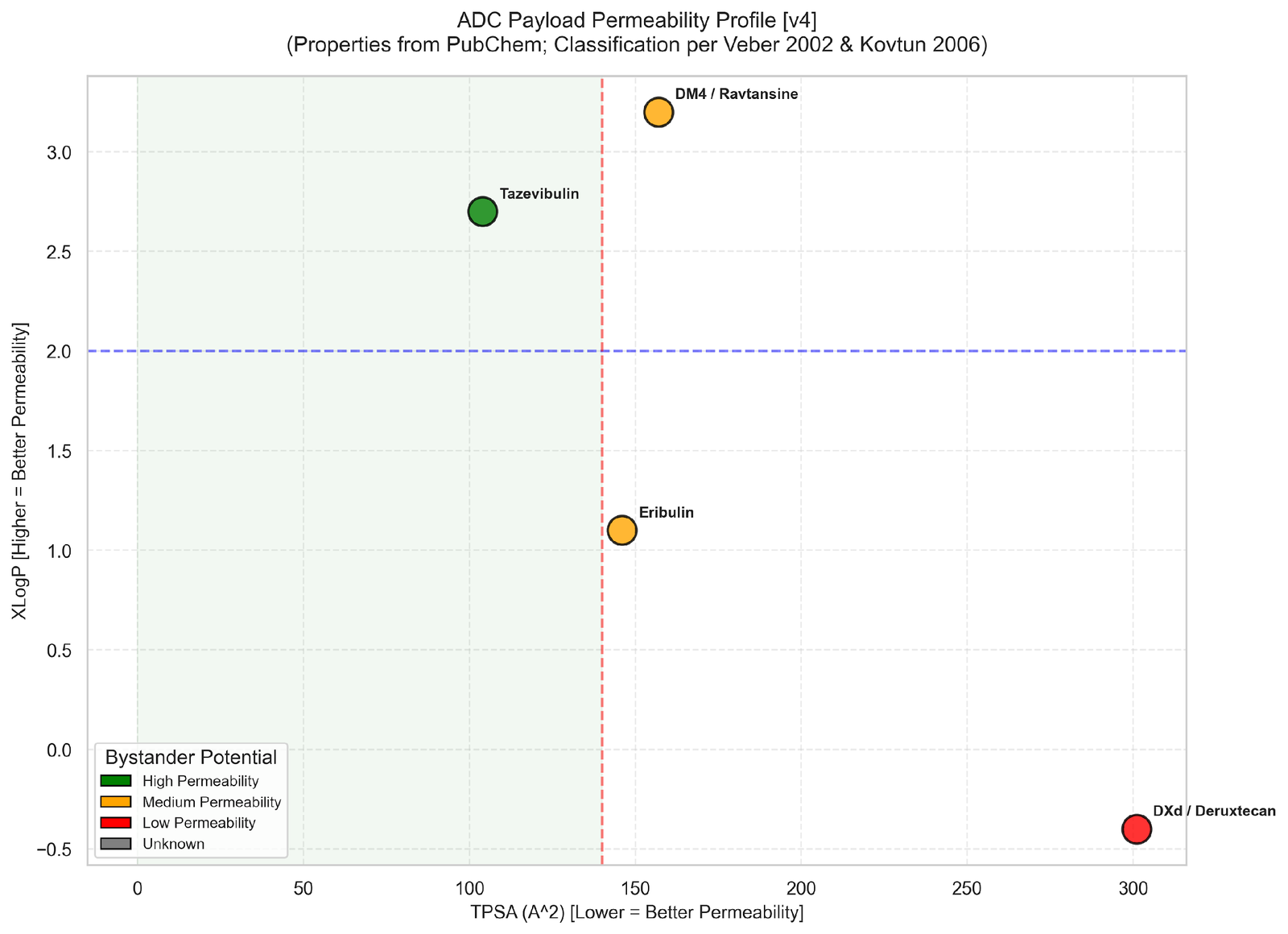
Payload permeability profile (XLogP vs TPSA). Hemiasterlin (Sutro’s STRO-002) falls in the High zone; DXd (Genmab/AZ’s Rina-S) is Low.
Why permeability matters — the bystander effect
A highly permeable payload, once released, can diffuse back across the membrane and kill neighbouring cells — including antigen-negative tumour cells the antibody never bound. In FRα ovarian cancer, where expression is frequently heterogeneous, this is a practical design constraint, not a theoretical one: even in a perfectly selected “high-FRα” patient, individual cells vary in expression. Patient selection cannot compensate for that; a permeable payload can. Demonstrated directly for maytansinoid and auristatin payloads (Kovtun et al. 2006; Li et al. 2016).
3.2 Patient-selection strategy
Mirvetuximab’s programme is defined by biomarker-guided selection: 19 of its 26 trials (73.1%) require explicit FRα thresholds, many demanding ≥75% tumour positivity by IHC. The other agents have smaller, earlier-stage programmes with lower proportions of biomarker enrichment.
| Agent (company) | Trials | FRα selection | Score |
|---|---|---|---|
| Mirvetuximab (AbbVie) | 26 | 19 (73.1%) | 0.731 |
| STRO-002 (Sutro) | 6 | 2 (33.3%) | 0.333 |
| Rina-S (Genmab/AZ) | 3 | 1 (33.3%) | 0.333 |
| MORAb-202 (Eisai) | 4 | 1 (25.0%) | 0.250 |
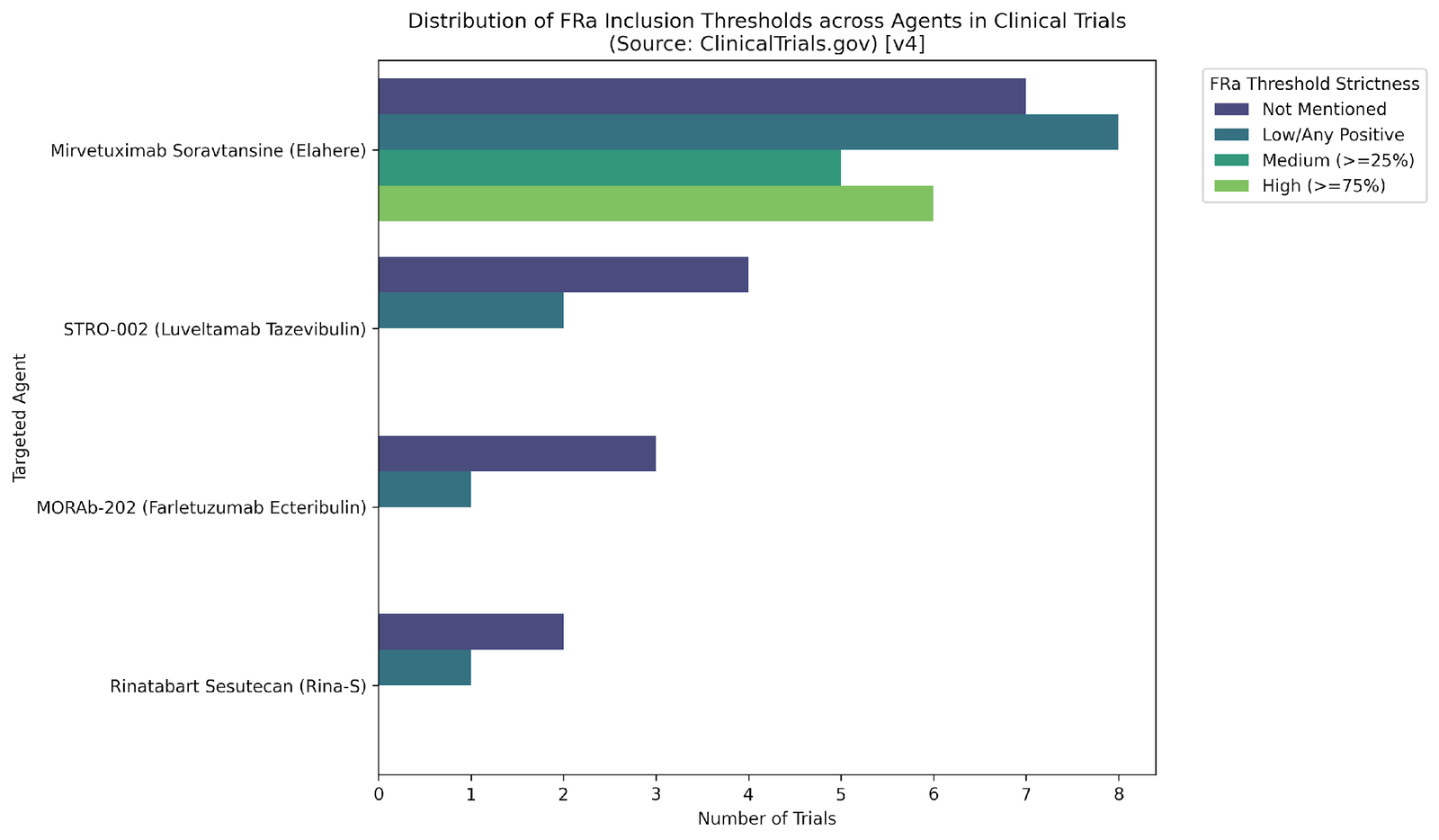
Distribution of FRα threshold classes across the four ADC programmes.
Patient selection by IHC is replicable, not proprietary — any competitor can adopt the ≥75% threshold (recent STRO-002 data already shows ORR 43.8% at FRα >25%). The distinction that matters: patient selection gets you into the game; intrinsic ADC properties determine whether you win it.
3.3 Does high FRα expression predict efficient processing?
If FOLR1 were tightly co-regulated with lysosomal proteases and endosomal trafficking, patient selection alone might guarantee efficacy. If not, there is a gap that ADC engineering — payload permeability — must fill.
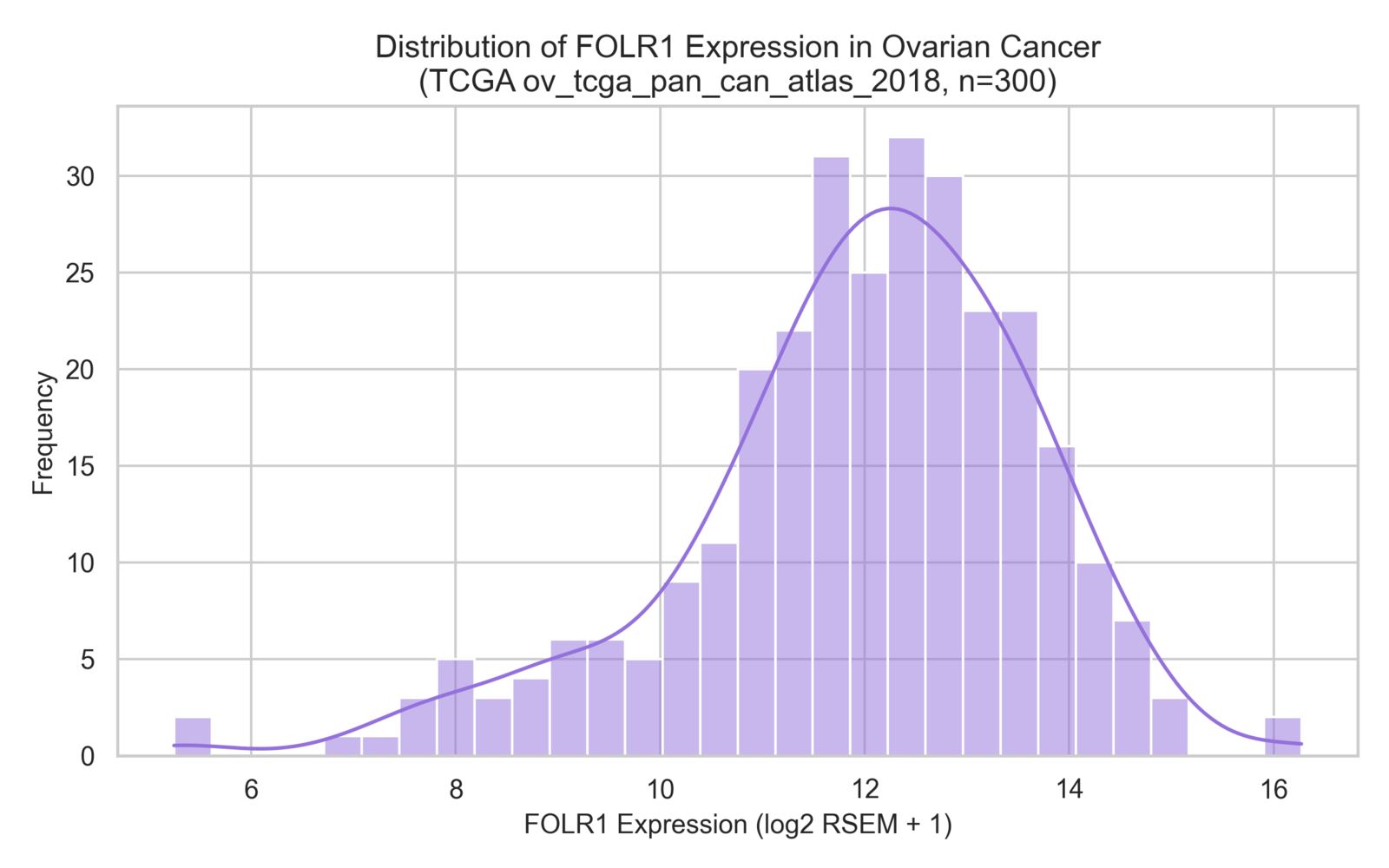
FOLR1 mRNA expression across ~300 TCGA ovarian cancers. mRNA is a proxy for protein; surface abundance is shaped by post-translational processing, GPI-anchor assembly, recycling and internalisation, none captured by bulk RNA-seq.
| Marker | Role | Spearman r | p | Interpretation |
|---|---|---|---|---|
| CTSB | Lysosomal protease; cleaves Val-Cit | 0.012 | 0.831 | No correlation |
| LAMP1 | Lysosome abundance | 0.171 | 0.003 | Weak positive |
| RAB5A | Early-endosome trafficking | 0.036 | 0.536 | No correlation |
| CTSD | Aspartyl protease | 0.200 | 0.0005 | Weak positive |
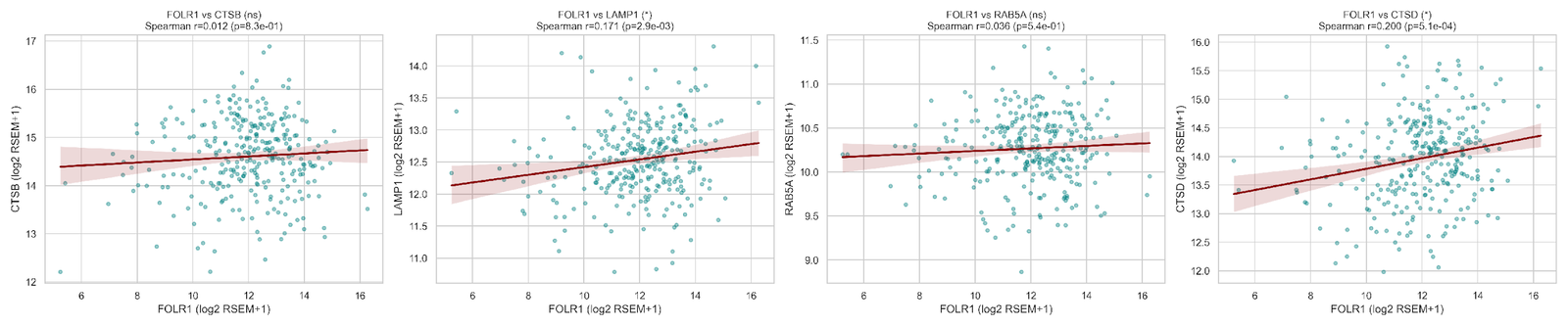
FOLR1 vs processing markers. Only LAMP1 and CTSD show weak but statistically significant correlations.
High FOLR1 mRNA does not reliably predict abundant lysosomal enzymes or efficient trafficking. The strongest correlation (CTSD, r = 0.20) explains only ~4% of the variance; CTSB and RAB5A show essentially none. So even in IHC-selected patients, cells vary widely in how efficiently they process an internalised ADC — a biological rationale for permeable payloads that goes beyond expression heterogeneity, and one patient selection cannot replicate.
3.4 Integrated comparison
Bringing the ADC-specific and patient-selection dimensions together reveals where each agent leads and where it is exposed.
| Agent | Affinity | Epitope | Permeab. | Clinical | Composite |
|---|---|---|---|---|---|
| Mirvetuximab (AbbVie)* | 0.723 | 1.000* | 0.500 | 0.731 | 0.739 |
| STRO-002 (Sutro)~ | 0.474~ | 1.000~ | 1.000 | 0.333 | 0.702~ |
| Rina-S (Genmab/AZ)~ | 0.474~ | 1.000~ | 0.200 | 0.333 | 0.502~ |
| MORAb-202 (Eisai) | 0.000 | 1.000 | 0.500 | 0.250 | 0.438 |
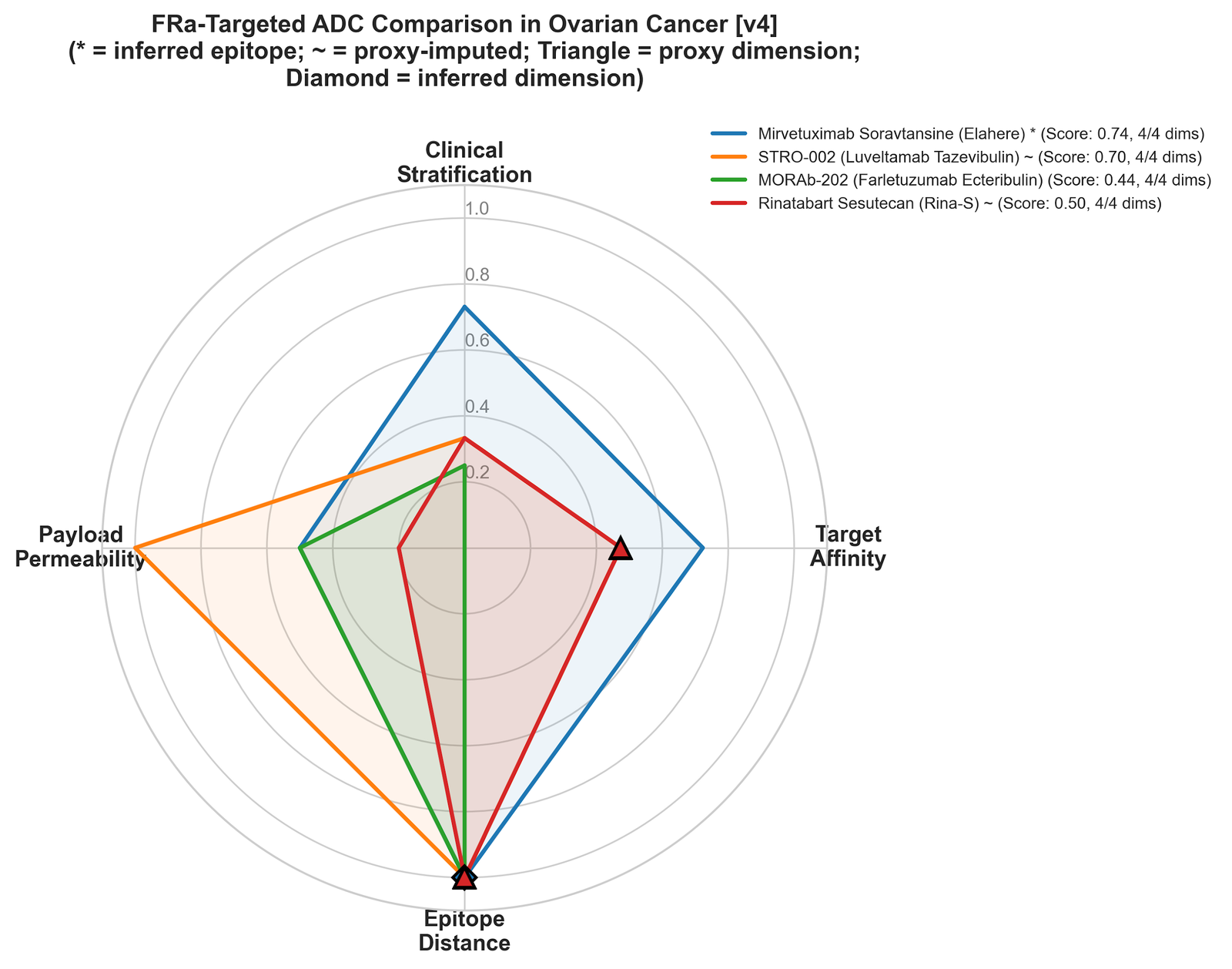
Radar chart comparing the four FRα ADCs. Mirvetuximab bulges toward Clinical (selection) and Affinity but is middling on Permeability; STRO-002 bulges toward Permeability but is weak on Clinical.
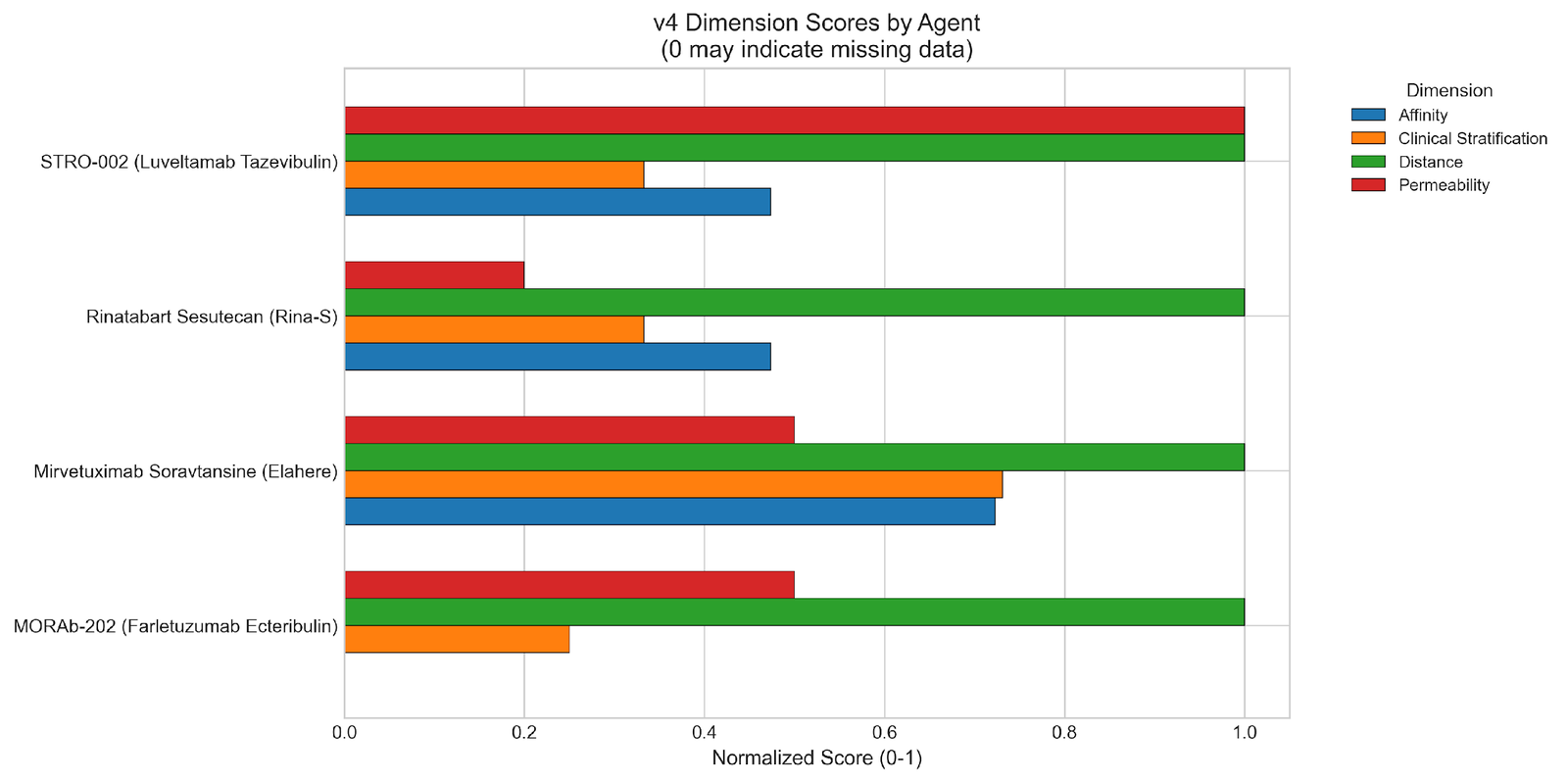
Dimension scores by agent. Mirvetuximab’s advantage is primarily programme design; STRO-002’s is primarily intrinsic ADC properties. The best-in-class question is whether one molecule can combine both.
4. What would a best-in-class FRα ADC look like?
Mirvetuximab’s lead is built on good — but not exceptional — ADC properties plus an exceptionally well-designed selection programme. On intrinsic properties alone, the picture is more open. Read straight off the data, the target design specification is:
Binding affinity Kd ≤ 2 nM. Match or beat Mirvetuximab’s 1.8 nM. The 1–2 nM range balances receptor occupancy against the binding-site barrier; Farletuzumab’s 6.5 nM is likely below a BIC threshold.
High-permeability payload (XLogP ≥ 2.0, TPSA ≤ 140 Ų). The single biggest lever. Enables bystander killing to cover both expression and processing heterogeneity. Hemiasterlin already clears this bar; DM4 just misses (TPSA 157).
No payload class ruled out. Data favours permeable tubulin inhibitors, but topo-I payloads (DXd) have proven efficacy elsewhere (T-DXd in HER2+). DAR 8 partially offsets low permeability.
≥75% IHC selection = table stakes. Necessary for approval, not a differentiator. The richer question is whether to stratify on functional readouts (lysosomal capacity, internalisation) beyond surface expression.
5. Conclusion: the path to best-in-class runs through engineering
The data supports a specific reading: Mirvetuximab succeeded primarily because of its patient-selection programme, and there is meaningful room to improve on its intrinsic engineering. Patient selection is necessary to demonstrate efficacy in a regulatory context; payload and antibody design are what create a genuinely differentiated molecule. The three priorities for any FRα ADC programme: increase payload permeability, target affinity ≤ 2 nM, and treat ≥75% IHC selection as standard practice rather than a moat.
References & data availability
All data is publicly available. Clinical trials: ClinicalTrials.gov. Structure: RCSB PDB 4LRH. Compounds: PubChem (CIDs 11686439, 5352092, 11354606, 118305111). Expression: cBioPortal / TCGA (ov_tcga_pan_can_atlas_2018). Binding affinities from cited literature.
- Chen C et al. Structural basis for molecular recognition of folic acid by folate receptors. PNAS 2013;110(39):15769–74.
- Ab O et al. IMGN853, a folate receptor-alpha-targeting ADC. Mol Cancer Ther 2015;14(7):1605–13.
- Ebel W et al. Preclinical evaluation of MORAb-003. Cancer Immun 2007;7:6.
- Veber DF et al. Molecular properties influencing oral bioavailability. J Med Chem 2002;45(12):2615–23.
- Kovtun YV et al. ADCs designed to eradicate tumors with heterogeneous expression. Cancer Res 2006;66(6):3214–21.
- Li F et al. Intracellular released payload influences potency and bystander killing. Cancer Res 2016;76(9):2710–19.
- Moore KN et al. Mirvetuximab soravtansine in FRα-positive, platinum-resistant ovarian cancer. NEJM 2023;389(23):2162–74.
- Bhakta S et al. An anti-FRα ADC, STRO-002. Mol Cancer Ther 2021.
This analysis is illustrative, not definitive, and was reviewed by a human researcher for scientific accuracy. It demonstrates how an agentic AI workflow compresses weeks of manual landscape research into hours — and the same framework can be repointed at any target, indication, or competitive set.
How to Create a Best-in-Class FRα ADC
The full analysis behind this study: four FRα ADCs scored across binding affinity, payload permeability, epitope position and patient-selection stringency, with the composite scoring framework and every data source.
Run this analysis on your question
Hydra plans, executes, and validates, so you reach a defensible answer in hours, not weeks.
What you get
- A plain-language read on why one ADC won and three are still chasing - failing vs. successful, side by side
- A best-in-class design spec: ≤2 nM affinity, high-permeability (bystander) payload, ≥75% IHC selection, possible novel epitope
- A clean split between replicable programme design and genuine, intrinsic molecular advantage
- The honest caveats stated up front (mRNA ≠ surface protein), so the result is safe to act on
- Weeks of manual landscape work compressed into hours, from one prompt, with the executable code attached
- A path from exploratory benchmark to production workflow on your own internal data
Sources & methods
- 01FRα structure: RCSB PDB 4LRH (Chen et al., PNAS 2013)
- 02Permeability thresholds: Veber et al., J Med Chem 2002; Kovtun et al., Cancer Res 2006
- 03Bystander killing: Kovtun et al. 2006; Li et al., Cancer Res 2016
- 04Landscape & expression: ClinicalTrials.gov; PubChem; cBioPortal / TCGA
Figures reflect analyses PharosBio ran on public datasets and public benchmarks; the methods and results shown are real and repointable to your own target.
Frequently asked questions
What actually separated the approved ADC from the ones that didn't make it?
Mostly patient selection, not a better molecule. ~73% of the winner's trials only enrolled patients whose tumours strongly express the receptor (≥75% by IHC), versus 25-33% for competitors. On intrinsic properties the field is even - except payload permeability, where a bystander-capable payload is the biggest real engineering edge.
What is the bystander effect, and why does it matter for an ADC?
Tumours express the target unevenly, so some cells have little or none of it. A 'permeable' payload can leak out of a cell it killed and diffuse into neighbouring cells - including ones the antibody never bound - and kill them too. That's the bystander effect, and it's an advantage built into the molecule that patient selection can't replicate.
Doesn't gene-expression data overstate how much receptor is really on the cell?
Yes - and Hydra flagged this itself. The tumour data measures mRNA, a proxy for protein. RNA levels don't capture processing, surface recycling, or internalisation, so 'high expression' on paper isn't the same as 'lots of target on the surface' in a patient. The result is reported with that caveat rather than overclaimed.
How long did this take, and how much was manual?
A single prompt, and a few hours of runtime. Hydra chose the data sources and methods, ran them in parallel, and produced a fully sourced benchmark. A scientist's job becomes validating and judging the output - not pulling four databases together by hand over several weeks.
Can Hydra plug into our internal data and become a repeatable workflow?
Yes. This benchmark runs on public data as an exploratory first step, and every analysis ships with the executable code behind it. Pharos can attach that workflow to your internal databases, documents, and proprietary data - turning a one-off benchmark into a production workflow you rerun and validate, and repoint at any target or indication.